Introduction
The Common Law of England and Wales comprises law built up from the judgments of decided cases in the higher courts, as opposed to Acts of Parliament. There are hundreds of cases relating to property boundaries and so it is safe to rely on these presumptions unless there is evidence to the contrary.
Ditch and Hedge Rule
Where two or more properties are separated from each other by a hedge and a ditch it is assumed that the landowner dug a drainage ditch, creating a bank upon which to plant his hedge and that the ditch would therefore be on the edge of his land, so that he would be shovelling the earth onto his own land.
In Scotland, where the boundary is a wall, fence or ditch alone then the boundary is presumed to exclude the wall, fence or ditch.
High Hedges
Local authorities have statutory power to handle complaints relating to high hedges under Part 8 of the Anti-Social Behaviour Act 2003. Before the local authority will act, however, you must first try every other reasonable method to resolve your dispute. The hedge must be so high as to adversely affect your enjoyment of the property.
This may result in a formal notice to the owner of the hedge advising what steps need to be taken to remedy the situation. The maximum penalty for failing to comply is a £1,000 fine.
You can contact Communities and Local Government about high hedge matters at hedges@communities.gsi.gov.uk.
High Hedge Law Restrictions
- The legislation does not require all hedges to be cut down to a height of 2 meters.
- You do not have to get permission to grow a hedge above 2 meters
- When a hedge grows over 2 meters the local authority does not automatically take action, unless a justifiable complaint is made.
- If you complain to your local authority, it does not follow automatically that they will order your neighbour to reduce the height of the hedge. They have to weigh up all the issues and consider each case on it's merits.
- The legislation does not cover single or deciduous trees.
- The local authority cannot require the hedge to be removed.
- The legislation does not guarantee access to uninterupted light.
- There is no provision to serve an Anti-social Behaviour Order (ASBO) in respect of high hedge complaints.
Fences
If the fence has posts or struts on one of its sides there is a presumption that the land owner on the side with the posts or struts is the owner of the fence.
Sometimes fences are supported by upright posts on one side. In such a case it is presumed that the owner of the fence is the one that faces the uprights posts.
Fences that adversely affect a neighbouring property can be removed after first obtaining an order from the court under the Property Law Act 1952.
Walls
Where the Title Register or Deeds do not state where the boundary lies and the boundary consists of a garden wall it is presumed to be immediately on the side of the wall furthest from the garden of the owner who erected the wall. This is based on the surmise that a builder would ensure to build it with its outer face on the edge of his own land.
The Access to Neighbouring Land Act 1992 allows for the right to carry out basic preservation work to the exterior walls of a house where they cannot be accessed from the owner's property, although written notice of an intention so to do must be provided to the neighbour, enforceable by court injunction where he will not allow access.
Rights in relation to party solid built walls (brick, stone, breeze block, concrete) are governed by the Party Wall Etc Act 1996. Party walls separate semi-detached and terraced houses. The Act provides that it should be assumed, unless there is contrary agreement, that the division of ownership is centred down the middle of the wall. Thus the expense of repair and maintenance is a joint one.
With regard to the height of garden walls and fences it often happens that the Title Register or Deeds create restrictions thereon, and the same would be enforceable by injunction if the height were to be exceeded.
Trees, Shrubs, Overhanging Branches and Roots
Where trees or shrubs form the boundary or part thereof they belong to the owner of the land upon which they are growing. Even where the branches, roots, fruit or leaves overhang, they still belong to the owner of the land upon which the tree is growing, subject to the right of the adjoining land owner to cut them back (and to pass them, including the fruit) to the owner. Cutting back beyond the boundary is not allowed.
Poison cannot be used to kill protruding tree roots as this may kill the tree.
Flats
There is a presumption that a flat includes the external walls even though the landlord would normally be legally responsible to carry out work to the exterior.
Highways
Where a road is unadopted the boundary of a property, in the absence of contrary agreement, will extend to the centre point of the road, passing and including any grass verges and pavements. If the road is adopted by the local authority, the adoption applies only to the surface thereof, and the airspace above and ground beneath still belongs to the frontager, i.e. the person whose house abuts that part of the road. Where valuable minerals lie beneath then normally the mines and minerals therein will have been excluded from ownership, and a statement to this effect will appear in Section A of the Title Register.
Land Registry Title Plans display only the curtilage of the property, edged in red ink and not the land outside of the curtilage and extending to the centre point of the road. This is simply the best practice rule of the Land Registry, to avoid confusion, and does not override the legal presumption of ownership.
Non-Tidal Rivers
Similarly to public highways, the boundary of land adjoining a non-tidal river is presumed to extend to the centre point of the river, and as the river changes course over time, then so does the boundary (save where the course of the river is changed by design).
Canals
Boundaries abutting a canal exclude the canal and its tow path.
River Islands
Islands in a non-tidal river belong equally to the adjoining land owners. The proportion owned will depend on where the mid point of the river bisects the island. Where the island lies to one side of the mid point it is owned by the owner of the land nearest it. Islands in tidal rivers or an estuary belong to the Crown.
Lakes
Unless the lake lies entirely within the grounds of the property owner there is no presumption of ownership.
Seashore
The foreshore is the land that lies between the high and low water marks of an ordinary tide , i.e.. between spring and neap tides, and is owned by the Crown, subject to any lettings. Boundaries adjoining the foreshore extend only to the very top of the foreshore and may move over time as the foreshore extends or withdraws due to rising or lowering sea levels.
T and H Marks
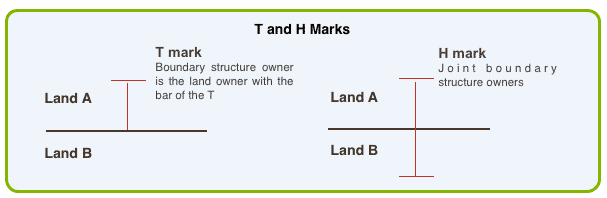
Although Title Plans rarely contain T and H marks there is often a reference to them in the Title Register, which is often mistaken for a reference to the Title Plan. Usually this reference appears in a citation of a clause from a Deed and actually refers to a Plan attached to the Deed. This is certainly worthwhile looking at. Such a Deed and its Plan will usually be held digitally by the Land Registry and is supplied with our Boundary Search.
A T mark contains one bar. The land upon which the bar is shown is the owner of the boundary structure. An H mark denotes joint ownership, there being a bar on each side of the boundary structure. There is often a reference in the Title Register to a Boundary Structure Notice, which would be part of a Deed containing a Deed Plan.
Horizontal Boundaries
There are 4 specific instances where boundaries may appear horizontally:
1 Underground Workings
Where there are underground mines, minerals or caves, which have been sold separately. The A section of the Title Register would contain a statement to the effect that the same are excluded from ownership.
2 Flats
Where a property is divided into flats there will be a detailed plan attached to the lease which will show the horizontal (and other) boundaries of the flats. A copy of the Lease is provided with our Boundary Search where one or more of the properties is a flat.
3 Creeping Freeholds (Cellars)
Where a cellar extends below another property there is a presumption that the same is owned by the owner of the house that has use of the cellar. In such cases the Land Registry will generally include a note in the Register for the flat above the cellar to the effect that the cellar is excluded from its ownership. There will also be a statement in the Register for the owner of the cellar to say that it is included.
4 Flying Freeholds
A flying freehold may be created where properties adjoin and the upper part of one of them contains one or more rooms that project above the adjoining property. As with creeping freeholds the Land Registry will make a note on the title of each Register.
Projections
The eaves and/or foundations of a property that project beyond the property boundary are not likely to appear in the Title Plan or any Deed Plans, as these will show the boundaries at ground level. Where this is the case the property ownership will include them, but will not include the air space projecting down from the eaves or up from the foundations, where the same projects beyond the boundaries of the property.